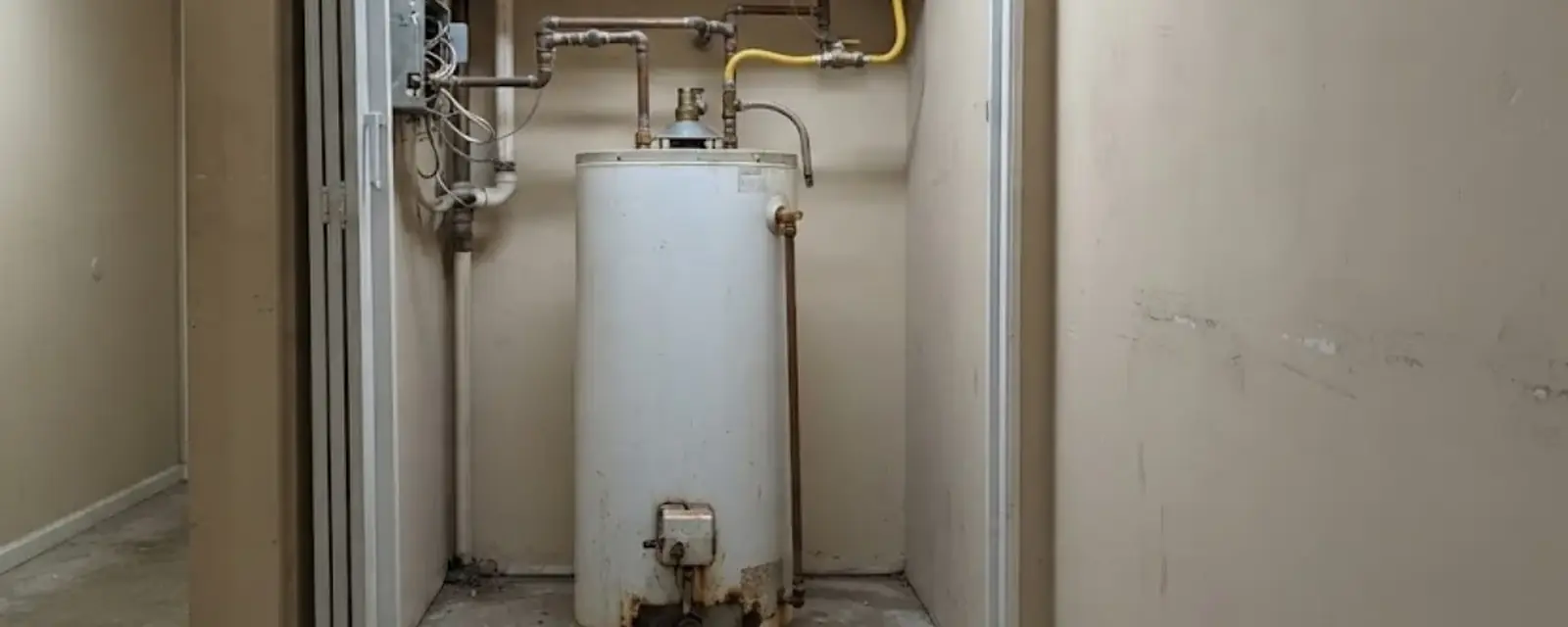
When a failed water heater is an emergency
A tank that has failed leaks. How much depends on how quickly someone notices. A basement heater leaking into an unfinished floor is a mess. The same leak near finished space, a laundry room or stored belongings becomes expensive in a few hours.
- Water at the base of the tank that keeps coming after you shut the supply
- Rust colored hot water that leaves stains in the tub
- A tank older than ten to twelve years with no hot water
- Popping or rumbling that returns after a flush
Shut off the cold water valve above the heater, turn off the power at the breaker or turn a gas control to pilot, then call. If there is standing water around an electric heater, do not walk into it until the power is off.
Replace or repair: a simple rule of thumb
A common rule is to weigh the repair cost against the age of the unit. If the tank is under about eight years old and the problem is a part, repair is reasonable. If it is past about ten years, the tank is leaking from the body, or the repair would cost half the price of a new unit, replacement is the better value.
Remember that a new water heater is also more efficient than an old one, which lowers fuel use. The water heater repair page covers what can be saved. This page covers what happens when it cannot be.
Choosing the right replacement
| Type | Good fit | Trade-off |
|---|---|---|
| Standard gas tank | Homes with gas service and a vent | Lower upfront cost, needs venting |
| Standard electric tank | Homes without gas | Simple install, higher operating cost |
| Hybrid heat pump tank | Basements with open air space | Highest efficiency, larger and needs drainage |
| Tankless gas | Households that run out of hot water | Higher install cost, gas line and vent upgrades |
Size matters more than people expect. A family of five in a large Colonial needs a different capacity from a couple in a Cape. The first hour rating on the yellow label tells you how much hot water the unit delivers in a busy hour. Ask the plumber to size from your actual use, not from the old tank alone.
What happens on replacement day
The plumber drains and disconnects the old tank, hauls it away and sets the new one. New connectors, a relief valve and discharge pipe, and a drain pan where space allows are part of a proper installation. A gas unit needs a leak test and a combustion and venting check. Electric needs correct wiring and breaker size.
Many houses also need an expansion tank when the water system has a check valve or a pressure reducing valve. It absorbs the extra pressure as the water heats. Ask if one is needed, and ask whether the old one is still good. A dead expansion tank is a quiet cause of dripping relief valves. Tank replacements are also available in Medford, where basement mechanical rooms in older buildings can be just as tight.
Older Winchester basements and tight utility rooms
Winchester has many houses from the 1890 to 1920 period and earlier, and their utility spaces were not designed for modern units. Low ceilings, narrow stair access and shared mechanical rooms are common. Measure the doorway and the stairs. A taller hybrid or tankless unit may need a different spot.
If the old heater sits on a wooden platform or stands in a damp corner, the plumber may suggest a better base. For a unit in a finished area, ask for a drain pan with a drain line. If you want to relocate the heater, see plumbing installation for what that involves.
What affects water heater replacement cost
There is no single price because the unit, the venting and the site vary. The main factors are:
Many homeowner policies do not pay to replace a worn-out heater but do cover resulting water damage. Utility or state rebates may exist for efficient models, so ask about current Mass Save offers before you buy. Want your real number? Call (339) 216-9771 and the price is agreed before work starts.
Need a new tank today?
Call the 24/7 line. Same-day appointments are offered when available.
Permits and who can pull them
Massachusetts consumer guidance says a local plumbing inspector issues the permit before plumbing is replaced, and permits are issued only to licensed plumbers. Winchester posts a Building Department page at Town Hall with a plumbing and gas inspector and online permit applications. Ask the plumber to confirm the permit before work starts and ask to see it.
Plumbing work in Massachusetts falls under the state plumbing code, 248 CMR 10.00, and plumbers are licensed through the Massachusetts Board of State Examiners of Plumbers and Gas Fitters. Ask any plumber to confirm their license and which permit the job needs before work starts.
Written by the Winchester Pro Plumbing team.
Water Heater Replacement questions in Winchester
A straightforward tank swap is a few hours. A fuel switch, new venting or a move to a tankless unit takes longer. The plumber gives a time window once the basement setup is known.
Replacement is generally permitted work in Massachusetts, and the licensed plumber pulls it. Confirm with the Winchester Building Department if your case is unusual.
Yes. A failed tank at 3 a.m. gets the same dispatch as a daytime call, and same-day replacement is offered when appointments and stock are available. Tell the dispatcher the tank size on the label and whether it runs on gas or electricity, so the right unit is on the truck.
It depends on household size, fuel costs and space. Tankless suits households that run out of hot water. A hybrid heat pump tank suits basements with room and high electric rates. Compare operating costs before the choice.
Look at the first hour rating, not just tank gallons. A household of two usually does fine with a smaller tank, while larger families need more capacity or a tankless unit.
Yes. Removal and haul away is part of a normal replacement. Ask that it is on the written price.